The Action at Stäket, 1719 per Russian Regimental Archive
Megorsky, Boris. The Action at Stäket, 1719 per Russian Regimental Archive. Unpublished manuscript, 2014.
Probably the last considerable battle of Russian and Swedish land forces in the course of the Great Northern War 1700 – 1721 attracted some attention in Sweden as it was “the last stand” in front of Stockholm against the invading enemy. For Russia the objective of those seashore operations being enforcement of peace negotiations through destruction of economy, so in Russian historiography military side of that raid hardly attracted any interest – and if mentioned at all was described basing on single official relation published in 1719. And it has long been a feature of Great Northern War writings that historians rarely used sources from the other side due to accessibility of materials and plain language issues. The purpose of this article is to put into use a Russian source material that wasn’t utilized by past generations of historians in both countries.
The Source
Arguably the richest source of data about Russian military during Great Northern War are so called “regimental tales (polkovaya skazka)”. In 1720 War Ministry took an impressing effort to collect records from all regular foot and dragoon regiments. After two decades of rather turbulent wartime units had to submit information about regimental history – when a unit was created, who were its commanders in their succession; on annual basis, what was stock of uniforms, equipment and weapons present in a regiment, what items were received and what were disposed of. In many cases records kept in regiments weren’t full – regimental chancelleries appeared to be lost, destroyed, sunk or burnt on various occasions during war. Still in situation when modern researchers have next to none information about regimental uniforms and arms, these papers are invaluable source. No less important is another part of the 1720 — 1721 paperwork that relates to officers and lower ranks. Every unit submitted records on how many men were present, what was their length of service. Then every officer submitted his personal autobiography “tale” (“ofitserskaya skazka”), describing his origin, when and where he started service, his promotions, awards, wounds and participation in actions. Wording of these documents is most often standard but in rare cases men went into details of their lives and in anyway this broad massive of documents contains precious information about individual careers during the war1.
Whole wealth of “regimental tales” is stored in Russian State Military History Archive (RGVIA) in Moscow and is still unpublished as a whole. Modern Russian historians started actively utilizing these documents during last decades, most notorious being Kirill Tatarnikov who published his book “Russkaya Polevaya Armiya 1700 – 1730” (“Russian Field Army 1700 – 1730”) with all data available about uniforms etc. for every single regiment. However, papers on few particular regiments were used already in early 20th century, when officers were preparing regimental histories to mark two-centenaries of their units. Most of them used and published just extracts from the “tales” and only one author published whole document.
Boris Viktorovich Adamovich (1870 – 1936) served in Life Guard Keksgolmsky (named after Kexholm) regiment, created museum of the unit and was collecting materials for to be written regimental history. After World War I and Civil war he left Russia and kept cherishing regimental memory abroad. The book was never published but in 1910 he published a collection of documents of Keksgolmsky regtimen’s predecessor. The title is: Adamovich B.V. Sbornik voenno-istoricheskikh materialov Leib-Gvardii Keksgolmskogo pola. T. 1. SPb, 1910. (Adamovich B.V. Collection of military-historical materials of Life Guard Keksgolmsky regiment. Vol. 1. Saint – Petersburg, 1910).
In the Russian Imperial army Keksgolmsky regiment traced its origins from Second Grenadier regiment – a unit that was created in 1710 as a combination of grenadier companies brought together from several regiments of the foot. It took part in sieges of Viborg and Kexholm in 1710, taking Helsingfors and campaign in Pomerania in 1713, was with galley fleet after 1716. The Second Grenadiers took part in 1719 expedition as a part of detachment under Colonel prince I. F. Boryatinsky.
Ranks’ autobiographies, published by Adamovich, contain few small but valuable mentions of the action at Stäket Sund. Corporal Grigory Kondyrev wrote down that he was wounded in his head with sword “at place Sundsteck”2. We know very little about nature of fighting on that place, but character of the wound suggests it was close combat when attacking some retrenchment.
Regimental doctor foreigner Fedor Klementiev explicitly states that he was present when “storming at place Stecke” which means an assault on a fortified position took place. One should not be surprised with Russian name of a foreign doctor. He was born in Riga under name Kleisner and served in Swedish army till the battle of Poltava after which he enlisted in Tsar’s service where his name transformed3. These two are the only mentions of any details of the action in individual records.
However, Adamovich published another bunch of papers from regimental archive dedicated to the case of Stäket. Several officers were awarded and promoted after the action but it was not clear if some of them were in fact present in battle line during the fight. This caused lengthy investigation where all officers were questioned by Military Collegium what they saw in action and whether they saw three individuals in question. In short, materials of the investigation tell that after three battalions of Boryatinsky landed, a supporting force was sent from the galleys. It consisted of men from different regiments with Cossacks and it only joined the landing force after the fight was over; all force then stayed in battle line till night where they “collected bodies”4.
Register of ammunition spent by 2nd Grenadier regiment in action of August 13th lists 8891 musket rounds (both ball and case shot). This speaks for some lengthy firefight. 540 iron hand grenades were spent too — which were most commonly used in attacking fortified positions rather than in open field5. Same paper lists other items of uniforms, equipment and weapons lost in action (or recorded so) and this information can give better understanding of outlook of soldiers that landed at Stäket in 1719.
The official relation on operations of Apraksin’s galley fleet from June 10 to August 19, 1719 was printed in St. Petersburg on August 306. Pages 7-11 tell about action at Stacket. To the north of Stacket strait galleys have disembarked 3 battalions under Colonel Strekalov – this force did not take part in action against Swedes. Other 3 battalions under Colonel prince Boryatinsky went to the south of the strait. Boryatinsky landed at 7 oclock afternoon August 13 and went away from the shore at distance of 1/8 mile (roughly 930 m, given mile is old Russian mile is 7467 m) where they saw the enemy staying behind stones in defense. Swedes attacked with 2 regiments of foot and one regiment of cavalry; the fight lasted one hour and a half, Swedes were repulsed and Boryatinsky remained on the field till next day when Apraksin sent order to go back to galleys. The text emphasizes that the battle was notorious for Swedes outnumbered Russians in infantry, and had cavalry and cannons which Russian didn’t have at all. Also, per prisoners taken, Swedish troops came there with Prince Hessenkassel, the spouse to Queen.
Total Russian casualties: killed 3 0fficers and 101 rank-and-files wounded 5 officers and 323 rank-and-files.
One has to keep in mind that the genre of official relations for the broad audience is subject to overstating one’s own achievements and belittling those of the enemy. Nor it was intended to provide any details. That is where the new source material will help us to find more particulars of that action.
Boryatinsky’s Landing Force
The full list of officers of Boryatinsky’s force – both those who were present in action and those joined it afterwards — can be composed basing on several documents published by Adamovich. Paperwork initiated after the battle of Stacket includes two registers of officers names signed by Prince Boryatinsky7 and by General Golitsyn8; then there are evidences of officers who joined Boryatinsky later9 as well as evidences of 17 officers where were asked whether they saw aforementioned officers of succour in their part of battle line10.
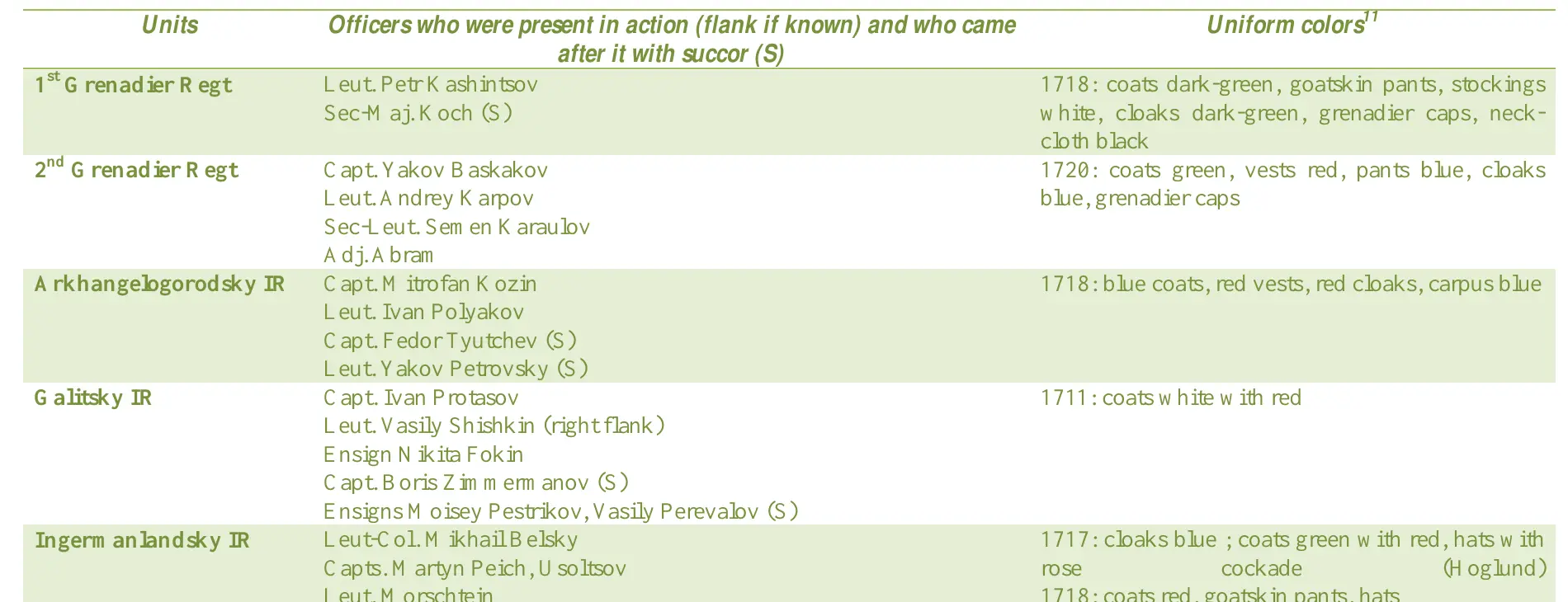
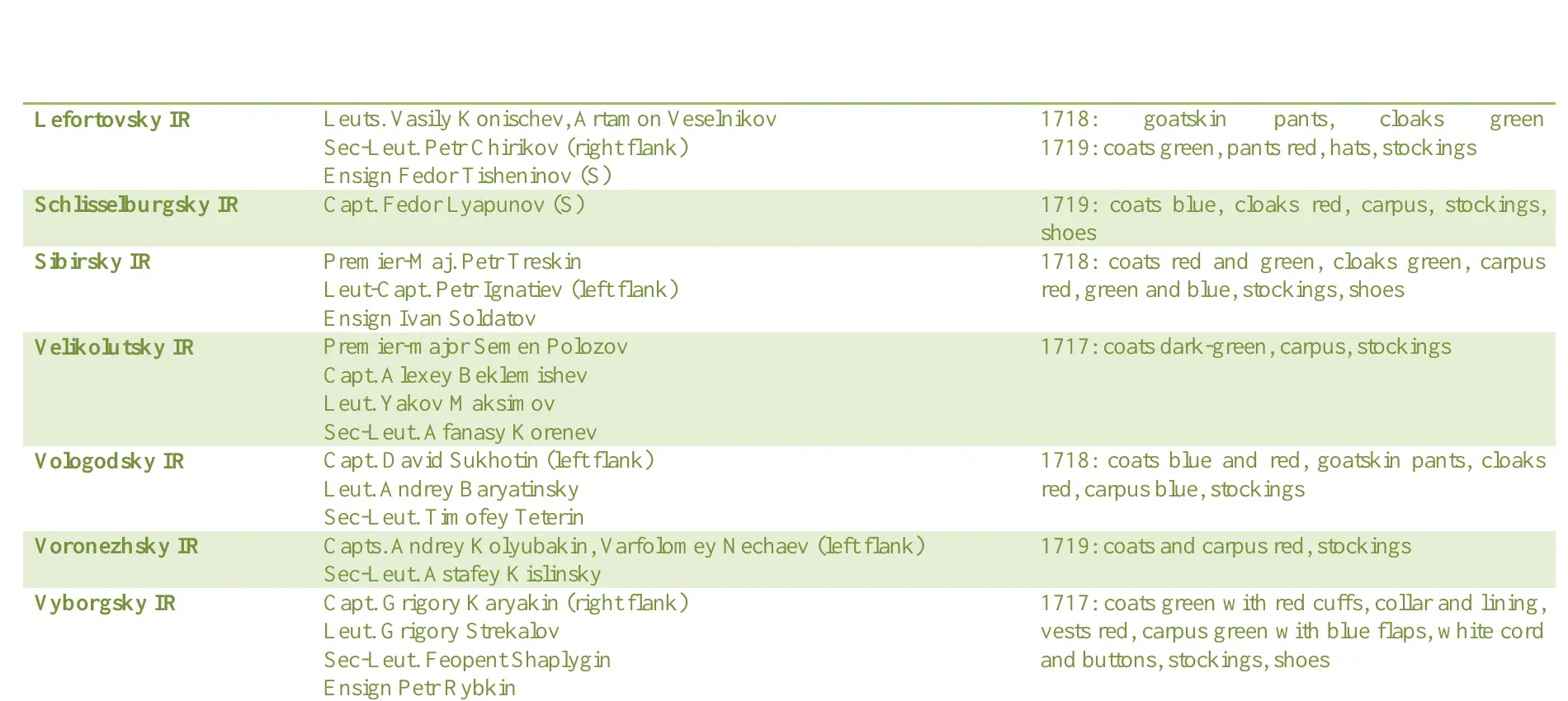
Considering ranks of officers in the list – as a rule a set of company level officers — we can assume that each regiment was represented by single company; thus Boryatinsky’s force was in fact not a full battalions but an assortment of 10 or 11 companies from different regiments. Official reports say about 3 battalions and this must be overall strength; it doesn’t look probable that they were full battalions belonging to one or two or three regiments.
17 officers who took part in battle under Boryatinsky were asked same questions – whether 3 officers were in battle line from the beginning or they arrived with succour and then whether this succor helped the line. Responses of these 17 persons not only confirm that they didn’t see the succour until after battle ended but also in many cases indicate in what part of line they were positioned (left or right flank). This allows us to re-construct, albeit with certain assumptions, the order of battle of Boryatinsky’s troops.
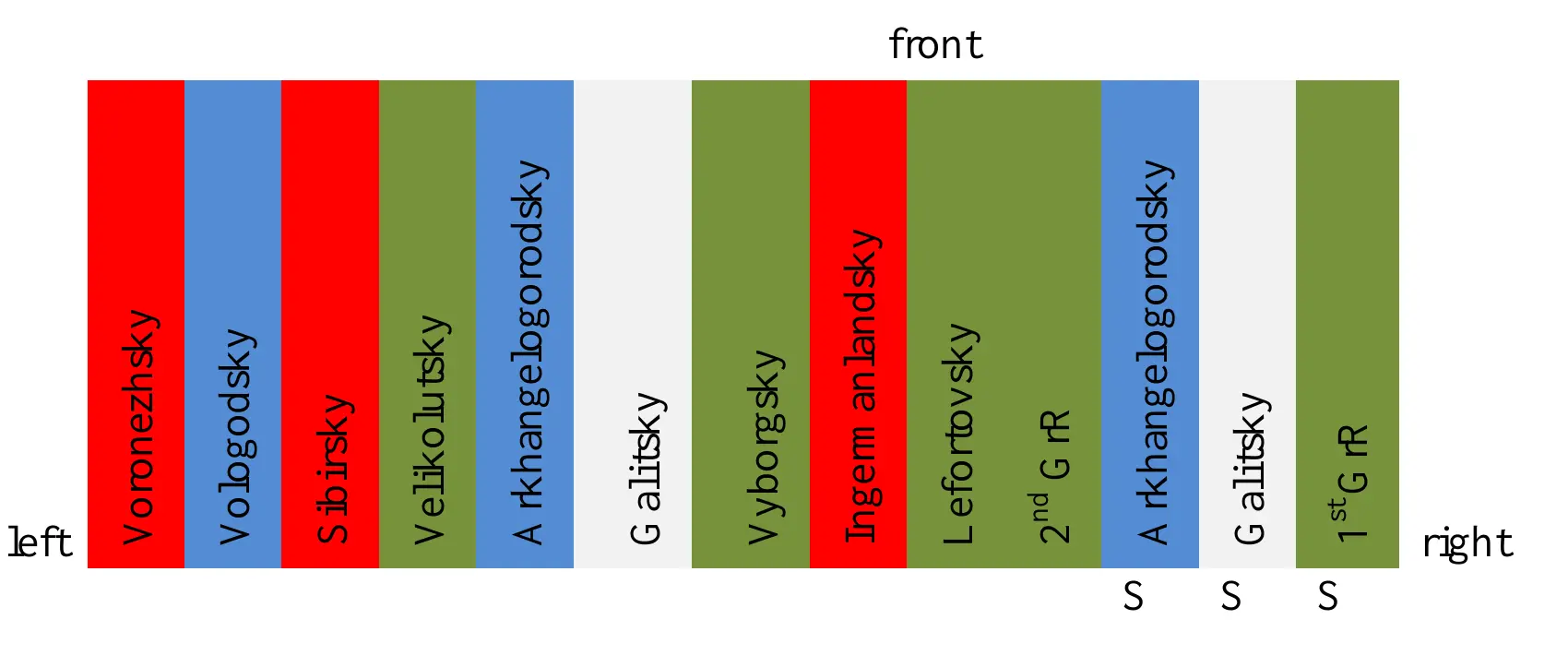
Supporting detachment was sent by Maj-Gen. Dupre from the place where galleys disembarked to the place where Colonel Prince Boryatinsky started action against Swedes. According to the list of officers we can tell that the ‘succour’ consisted of men of regts 1st Grenadiers, Arkhangelogorodsky, Galitsky, Lefortovsky, Schlisselburgsky.
Major Koch (1st GrR), according to himself, was sent to command this succour; upon arrival he with his grenadiers was placed on the right flank of the line and musketeers remained with Boryatinsky. Koch claims he was in firefight for more than half an hour and lost 3 men killed and 2 wounded. None of the officers present in action, however, could confirm they saw Koch in the course of battle; only few saw him after action ended on the right flank.
Officers of Arkhangelogorodsky regt (Capt. Fedor Tyutchev, Leut. Yakov Petrovsky) claimed: they disembarked from a horse galley together with cossacks near Boryatinsky’s galley. After action started in Boryatinsky’s force, Maj-Gen. Dupre sent them thither. Upon arrival, they were posted under command of Capt. Zimmermanov (Galitsky IR) near 2nd GrR on the right flank of the line, they stood just in 20 – 30 meters in front of the Swedes and were in action till the end and lost 1 sergeant killed and 4 soldiers wounded. None of the officers present in action, however, could confirm they saw Tyutchev and Petrovsky in the course of battle.
Officers of Galitsky IR (Capt. Boris Zimmermanov, Ensigns Moisey Pestrikov and Vasily Perevalov) claimed: they were detached from their regiment to the advance-guard squadron on a horse galley and were attached to Boryatinsky. When Boryatinsky disembarked and marched into the land he took with him Ensign Perevalov with his men. Others were told to form on the shore near the horse galleys and to be under Major Koch. After firing started between Boryatinsky and the Swedes, Maj-Gen. Dupre sent them thither. Boryatinsly ordered Capt. Zimmermanov to fulfill duties of Major and placed them into the battle line where they were involved in firefight together with others. However, register signed by General Golitsyn states they were not present in action and only arrived with succor after fight ended.
Detaching of Ensign Perevalov means that small sub-units were operated, not even full companies. Appointing Capt. Zimmermanov acting Major means the battle line was composed of ad-hoc formations, consisting of sub-units of different regiments.
Per 1708 and 1715 regulations Russian infantry formed 4 ranks deep and were trained to fire by platoons, by ranks and by volley. Although every company had it’s own flag in an infantry regiment, flags were carried in the center of parent battalion line, so it is questionable that companies took their flags with them when landing separately from their parent units. Grenadiers didn’t have flags at all.
2nd Grenadiers in Action
Having analyzed the order of battle we come to a surprising conclusion that only one company of the 2nd Grenadiers took part in the battle, the company of Captain Baskakov.
Register of ammunition spent by regiment in action of August 13th lists 4580 cartridges with roundball and 4311 cartridges with caseshot. As well were spent 540 iron hand grenades with 862 fathoms (1 Russian fathom = 216 cm) of slowmatch12.
We do not know exact strength of the company that day, but can assume it is reglemented 144 men as a maximum. Dividing all the spent ammunition by this number of grenadiers gives us an extraordinary spending – 62 rounds and 4 grenades per man. It is known that normally a soldier would carry 25 rounds and 2-3 grenades. It speaks for a very long and intense firefight. Extensive use of grenades might speak for attacking some defensive positions; this possibility is backed with two personal accounts mentioned before: one person claimed he was “at storm at Stacke”, another was wounded in his head with sword – something that can’t happen in a mere skirmish.
The grenadiers’ casualties are unknown, but there is list of uniforms, equipment and weapons lost in action. It can give an idea of overall losses and also can tell about outlook of soldiers that landed at Stäket in 1719.
| Equipment | Quantity | Weapons and uniforms | Quantity |
|---|---|---|---|
| Grenade bags with slings | 35 | Muskets | 35 |
| Grenadier cartridge pouch with sling | 41 | Swords with brass hilt | 54 |
| Brass match tubes | 56 | Bayonets | 63 |
| Sword belts with buckles | 70 | ||
| Powder horns | 43 | Grenadier caps | 25 |
| Water flasks | 48 | Cap covers | 33 |
| Musket worm and cleaning tool | 24 | Blue cloaks | 6 |
| Oiler | 41 | Green coats | 8 |
| Ranzel | 13 | Vests | 14 |
| Flintlock covers | 112 | Pants | 7 |
| Corporal lantern | 1 |
It is hard to derive unambiguous conclusion from this data. Although the document states the items were lost on August 13th, it is still probable that regiment lost part of the items earlier in the course of campaign and only showed them lost that day. It is also true that some of belongings could have been collected on the battlefield and brought back to galley and thus were not lost while their owners were killed. (Should also be noted that no footwear is mentioned, although it is known that by the end of 1719 grenadiers had both shoes with stockings and high boots).
Several approaches can be used to determine quantity of fallen grenadiers. First – take the most frequent amount of lost equipment and assume it correlates to casualties. In this case the loss was around 30-40. This looks feasible and it gives roughly 10% of total 423 men killed and wounded. Another approach – take amount of the lost personal belongings and assume it shows how many of their owners were killed; this would return roughly up to 14 men which makes reasonable proportion of killed to wounded. Still this is merely a speculation.
All in all the materials that were published by Adamovich in 1910 and haven’t been used so far in connection with the battle of Stacket, bring up new details and complement other sources including archeological findings on the battlefield, that are now exhibited in the new HAMN museum.
Notes
- 1. Soviet historian M.D. Rabinovich analyzed those tales in his two articles in 1970s: Офицерские «сказки» и послужные списки начала XVIII в. (Officers’ tales and service records of early 18th C.) Социальное происхождение и имущественное положение офицеров регулярной русской армии в конце Северной войны (Social background and property status of officers of the regular army in the end of GNW)
- 2. Adamovich. P. 138.
- 3. Adamovich. P. 99.
- 4. Adamovich. PP. 156, 172, 173.
- 5. Adamovich. P. 47.
- 6. Ведомости. № 15. Санкт-Петербург, 30 августа 1719 г. (The newspaper ‘Vedomosti’ from August 30, 1719).
- 7. Adamovich. PP. 158 — 159.
- 8. Adamovich. PP. 164 — 166.
- 9. Adamovich. PP. 167 — 171.
- 10. Adamovich. PP. 171 — 174.
- 11. Details taken from: Tatarnikov K. “Russkaya Polevaya Armiya 1700 – 1730” (“Russian Field Army 1700 – 1730”). Moscow, 2008.
- 12. Adamovich. P. 47.
Было интересно?
Добавьте «История.Главное» в предпочтительные источники Google. Так Google будет чаще показывать вам наши новые материалы.
Материалы по теме
Все темы →